
|
555 North Morton Street
Bloomington, Indiana 47404 phone 800.733.6786 | fax 812.336.7790 solution-tree.com |
|
||
|
|
Common Formative Assessment: A Toolkit for Professional Learning Communities at Work™
“Common Formative Assessment is one of the best toolkits for collaborative teams of educators committed to the PLC process that we have encountered. It provides the specificity and insights that can only come from authors who have not only led the PLC at Work™ process in their own school districts, but have also helped schools at all levels, in a variety of different settings, overcome the challenges inherent in deep implementation. Common Formative Assessment presents a compelling case for engaging educators in the kind of work that actually leads to improved student achievement.”
—From the foreword by Richard DuFour and Rebecca DuFour
|
|
|
|
Redefining Fair: How to Plan, Assess, and Grade for Excellence in Mixed-Ability Classrooms
“This is a great book! It will be useful for anyone struggling with the question of what is fair in instruction and assessment. Cooper bases his advice about fairness in mixed-ability classrooms on five imperatives, his own experience, and the dilemmas of teachers. His advice is broadly applicable, because all classrooms are mixed-ability classrooms.”
—Susan M. Brookhart, consultant, Brookhart Enterprises and senior research associate, Center for Advancing the Study of Teaching and Learning,
Duquesne University |
|
|
|
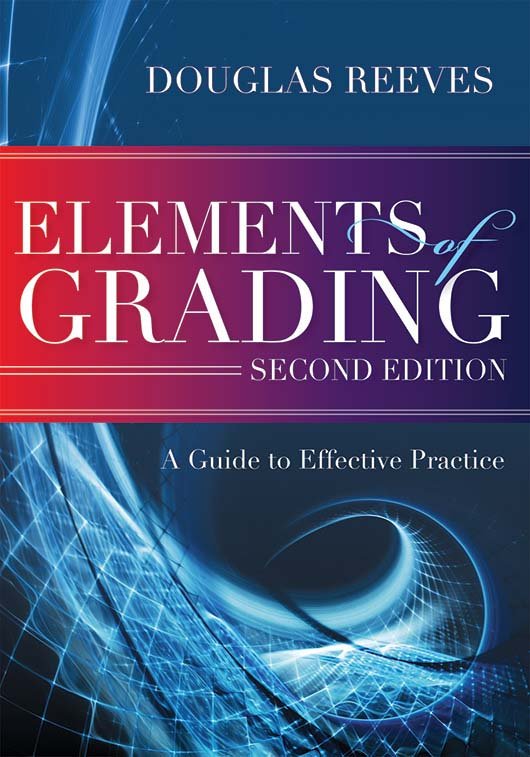
Elements of Grading: A Guide to Effective Practice
“For most teachers, grading students is a funky game—an enterprise ruled more by whim than rigor. Yet, in this exciting new book, Doug Reeves shows educators how they can make grading accurate, fair, specific, and timely. If, as he contends, 'grading is feedback,' then the grade Reeves earns for this volume is a glistening A-plus!”
—James Popham, professor emeritus, University of California, Los Angeles
|
|
|
|
Balanced Assessment: From Formative to Summative
“Kay Burke has created a practical resource for busy practitioners. Balanced Assessment: From Formative to Summative provides a comprehensive overview of the critical role that assessments, both formative and summative, play in today's classrooms. Burke promotes the use of performance-based tasks that make real-life connections, and she explains how to use rubrics to assess the critical skills and understanding that the tasks target. Performance tasks also allow teachers to differentiate instruction and assessment to meet the needs of all learners, including advanced and beginning students and English language learners.”
—Lisa Almeida, senior professional development associate,
The Leadership and Learning Center, Englewood, Colorado |
|
|
|
The Teacher as Assessment Leader
“The authors of each of these chapters derived their ideas through hard-earned experience. . . . They are not writing from an ivory tower or from the comfort of a research center, but from the front lines, where they have learned firsthand about the real challenges and difficulties that teachers face in their efforts to improve the learning outcomes of all students.”
—From the introduction by editor Thomas R. Guskey
|
|
|
|
The Principal as Assessment Leader
“Readers will be deeply impressed by the authors’ insights, the diversity of their perspectives on improvement, and the creativity and breadth of their proposed solutions. . . . Just as a ‘one size fits all’ approach does not work in teaching, it does not work in leadership, either.”
—From the introduction by editor Thomas R. Guskey
|
|
![]() |
Focused Assessment: Enriching the Instructional Cycle “This is an excellent assessment resource. . . . Through the use of realistic scenarios, she skillfully guides the reader through an analysis of the standards, selection of appropriate assessments, and a positive, step-by-step collaborative procedure.” —Linda Gregg, professional development associate, |
|
|
Gain additional assessment training through events and customized professional development.
|
||
|
|
||